How Do You Know a Flagpole Actually Needs Repair?
The clearest sign is a flag that won't stay at the top. Either the halyard slips, or the flag drifts down overnight because the hardware holding the rope has worn out. Several other signs are just as telling once you know where to look on the pole.
- Flag creeping down the pole after you tie it off
- Grinding or squealing from the truck at the top
- Pole leaning or rocking at the ground sleeve
- Halyard rope that's frayed, faded, or stiff to the touch
- Constant clanging of rope or snaps against the pole
Why Does the Flag Creep Down the Pole After It's Tied Off?
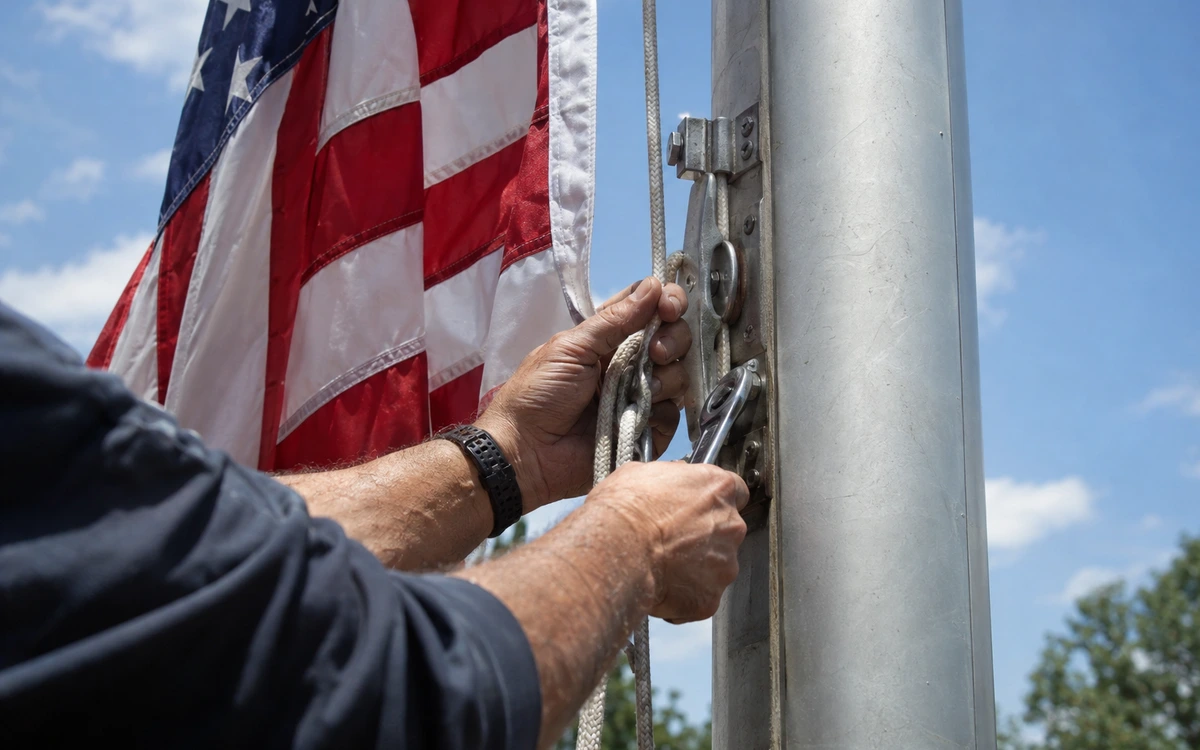
Nine times out of ten, the cleat is to blame. Either its mounting screws have loosened in the aluminum, or the rope wasn't wrapped around it enough times to hold under wind load. Every gust shock-loads the halyard, and a cleat that shifts even slightly lets the rope slip a few inches each time. The fix is usually to tighten the cleat or replace it with stainless fasteners, then tie off with a proper figure-eight wrap. If the cleat is solid and the flag still drifts, the halyard has probably stretched and needs replacing.
Does a Squealing Truck at the Top Mean the Whole Pole Has to Come Down?
Rarely. The truck is the revolving cap assembly at the peak, and the squeal comes from a dry or corroded pulley sheave or a seized bearing inside it. On most residential poles, a tech can reach the truck with a bucket lift or extension equipment, or simply lower a tilting pole, then swap the sheave or the entire truck without pulling the pole out of the ground. Ignoring it is what makes this a bigger job: a sheave that locks up starts sawing through the halyard, and a truck that stops rotating lets the flag wrap around the pole when the wind shifts.
Is a Pole That Rocks at the Ground Sleeve Just Loose Wedges?
Not always. That's the hopeful explanation, and sometimes it's the right one. The wood or rubber wedges between the pole and the foundation sleeve shrink, rot, or work loose over a few seasons, and new wedges, fresh sand fill, and a sealed top collar can stop the movement. But if the concrete footing has cracked or heaved from frost, re-wedging only hides the problem until the next storm puts lateral load on it. Before assuming it's a cheap fix, check the concrete around the sleeve for hairline cracks or gaps, and inspect the base of the pole for flex marks or dents.
What's Causing the Halyard Rope to Fray and Stiffen?
UV breaks down the halyard's outer braid first, which is why an aging rope looks chalky and feels stiff long before it snaps. Braided polyester and nylon halyards are standard, and in full sun they often need replacing every couple of years, even when the core still seems sound. Fraying concentrated in one spot points to a mechanical cause instead, usually a rough sheave edge at the truck or a burr on the cleat. Replace the rope and track down that contact point on the same visit, or the new halyard will wear through in the same place.
Can the Constant Clanging Against the Pole Cause Real Damage?
Yes, and it does more than keep the neighbors up. Metal snap hooks slapping an aluminum or fiberglass pole in every breeze chip the anodized or painted finish, and once that finish is gone, the exposed spots start to pit and oxidize. Snap covers or vinyl-coated snaps, combined with a halyard properly tensioned at the cleat, will quiet it down. An internal halyard system eliminates the noise entirely by running the rope inside the shaft. If a pole that used to be quiet suddenly starts clanging, the halyard has usually stretched, so check its tension before blaming the snaps.
How Much Does Flagpole Repair Cost in Hempstead, NY?
Flagpole repair in Hempstead, NY typically runs between $214 and $2,018. Where a job lands depends mostly on what failed and how hard it is to reach. Replacing a halyard, a cleat, or a set of snap covers sits at the low end. A seized truck or sheave costs more, especially on a non-tilting pole that needs a bucket lift. Foundation work tops the range: a cracked or frost-heaved footing means pulling the pole and resetting the sleeve in fresh concrete.